In the sophisticated landscape of modern fire safety, every component plays a decisive role in protecting life and property. Among these, the Fire Extinguisher Pressure Gauge stands as the most vital visual diagnostic tool. It is more than just a mechanical dial; it is the sole window into the internal readiness of a life-saving device. When a fire breaks out, there is no time for second-guessing; the Fire Extinguisher Pressure Gauge must provide an instant, honest assessment of the tool in your hands.
Ningbo Kaituo Valve Co., Ltd. (widely recognized as Ningbo Anke Fire Equipment Co., Ltd.) has spent decades perfecting the engineering behind these critical instruments. As a dynamic, high-tech factory specializing in the research, development, and export of fire protection equipment, we understand that a Fire Extinguisher Pressure Gauge must be unfailingly accurate. With our proprietary anke brand and a portfolio of national high-tech patents, we provide the global market with pressure monitoring solutions that meet the most rigorous international standards. Founded in 2001, our company has evolved through continuous process reform to become a leader in the fire accessory industry.
Defining the Fire Extinguisher Pressure Gauge and Its Core Functions
A Fire Extinguisher Pressure Gauge is a specialized pressure-sensing instrument mounted on the valve body of a stored-pressure fire extinguisher. Its primary mission is to provide a real-time measurement of the internal propellant gas—usually nitrogen or compressed air—that is responsible for expelling the extinguishing agent. Without this pressure, the chemical powder or water inside the cylinder remains trapped, rendering the device useless in an emergency.
- Instant Readiness Verification: The most immediate benefit of a Fire Extinguisher Pressure Gauge is the ability to confirm equipment status in seconds. During monthly safety walk-throughs, the gauge allows safety officers to verify that a unit is pressurized and ready for action without needing to discharge the unit or perform heavy weighing procedures.
- Operational Safety Warning: Beyond just showing if a unit is "full," a Fire Extinguisher Pressure Gauge serves as an early warning system against over-pressurization. If environmental heat causes internal gases to expand beyond safe limits, the gauge will reflect this, alerting users to a potential risk of cylinder failure.
- Performance Assurance: Fire suppression relies on the velocity and reach of the agent. The Fire Extinguisher Pressure Gauge manufactured by Ningbo Kaituo Valve Co., Ltd. ensures that the propellant is at the exact PSI required to throw the chemical powder or foam onto the base of a fire from a safe distance.
Mechanical Construction and Operating Principles
A high-quality Fire Extinguisher Pressure Gauge is a feat of precision engineering. Its ability to withstand years of static pressure while remaining sensitive to tiny fluctuations is a result of meticulous manufacturing. At Ningbo Anke Fire Equipment Co., Ltd., we focus on the durability of the internal mechanisms to ensure longevity in various climates.
The Internal Engine: The Bourdon Tube
The heart of any Fire Extinguisher Pressure Gauge is the Bourdon tube. This is a curved, flattened metallic tube usually made from a specific copper alloy or high-grade stainless steel. When the internal pressure of the extinguisher enters the tube, the pressure forces the tube to try and "straighten" itself. This minute physical movement is captured by a precision-linked gear mechanism that translates the motion into the rotation of the pointer across the Fire Extinguisher Pressure Gauge face. We select materials with a high elastic modulus to ensure that the Bourdon tube returns to its exact zero position even after years of continuous tension.
Exterior Protection and Robust Sealing
To survive the harsh environments of industrial plants, marine vessels, and outdoor installations, our Fire Extinguisher Pressure Gauge units are built with multi-layered protection:
- Lens Material: We utilize high-strength tempered glass or impact-resistant polycarbonate. This ensures that the Fire Extinguisher Pressure Gauge face does not crack under heat or shatter upon accidental impact.
- Case Construction: Cases are typically forged from corrosion-resistant brass or stainless steel. For marine applications, the anke brand gauges undergo specialized salt-spray resistance treatments to prevent oxidation.
- Precision Sealing: The connection point between the Fire Extinguisher Pressure Gauge and the valve is sealed with high-grade EPDM or Nitrile O-rings. This prevents the "micro-leaks" that are the leading cause of extinguishers losing pressure over several years.
Technical Parameter Comparison: Fire Extinguisher Pressure Gauge Specifications
Choosing the correct Fire Extinguisher Pressure Gauge requires an understanding of different technical specifications. Below is a comparison of the core gauges produced by Ningbo Kaituo Valve Co., Ltd. for various global requirements:
| Feature |
Standard Dry Powder Gauge |
Heavy Duty Industrial Gauge |
Marine Grade Gauge |
| Typical Range |
0 - 300 PSI (20 Bar) |
0 - 450 PSI (31 Bar) |
0 - 400 PSI (28 Bar) |
| Shell Material |
Chrome-Plated Steel |
Solid Brass |
316 Stainless Steel |
| Accuracy Class |
± 5% Full Scale |
± 2.5% Full Scale |
± 1.5% Full Scale |
| Corrosion Resistance |
Standard |
High |
Extreme (Salt Spray >480h) |
| Certifications |
CE / EN3 |
CE / UL |
CE / MED (Wheelmark) |
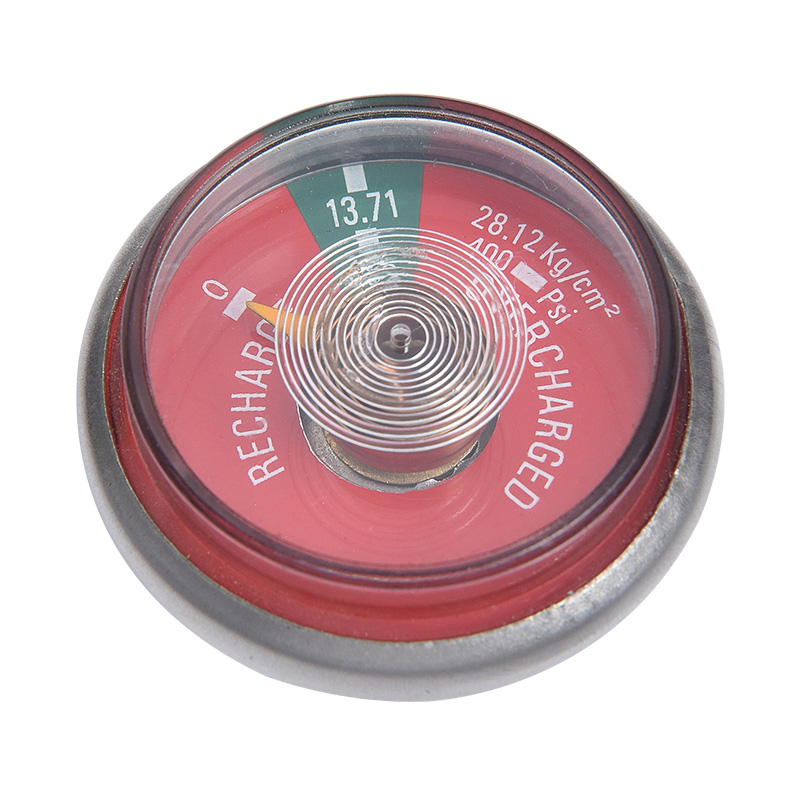
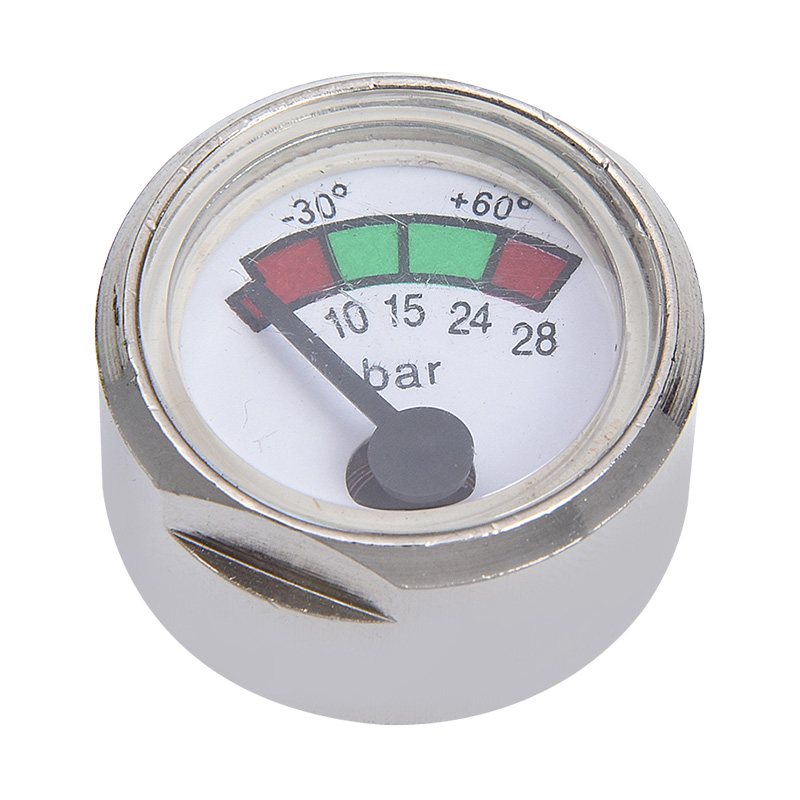
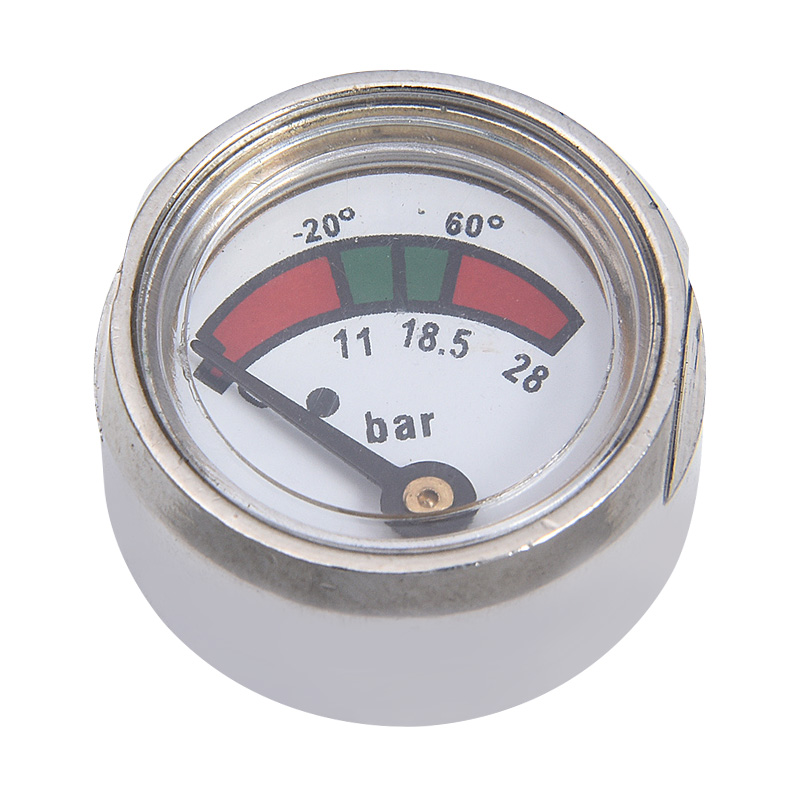
Decoding the Color-Coded Zones of a Fire Extinguisher Pressure Gauge
The color coding on a Fire Extinguisher Pressure Gauge is designed for high-stress situations, allowing even an untrained person to make a split-second decision. However, the science behind these colors is quite specific and calibrated during the anke manufacturing process.
The Green Zone (Operating Range)
This is the "Goldilocks" zone. When the pointer is in the green, the Fire Extinguisher Pressure Gauge confirms that the internal pressure is within the manufacturer's specified range (usually 85% to 115% of the nominal working pressure). This indicates that the propellant is perfectly balanced to expel the agent at the designed flow rate and distance.
The Left Red Zone (Recharge / Discharged)
If the pointer falls into the left red section, the extinguisher is "depressurized." This may occur because the unit was partially used, there is a leak in the valve seat, or the Fire Extinguisher Pressure Gauge itself has failed. Ningbo Kaituo Valve Co., Ltd. advises that any unit with a pointer in this zone is considered non-functional and must be taken out of service immediately for professional recharging or replacement.
The Right Red Zone (Overcharged)
An overcharged Fire Extinguisher Pressure Gauge indicates a dangerous situation. High pressure can be caused by improper filling or exposure to extreme heat. An over-pressurized cylinder poses a risk of valve failure or, in extreme cases, a catastrophic rupture of the cylinder itself. Our Fire Extinguisher Pressure Gauge designs include safety margins to handle temporary spikes, but persistent overcharge requires immediate attention.
Manufacturing Excellence at Ningbo Anke Fire Equipment Co., Ltd.
Since our founding in 2001, Ningbo Kaituo Valve Co., Ltd. has remained at the forefront of fire protection technology. The production of a Fire Extinguisher Pressure Gauge in our facility involves several high-tech stages to ensure every unit exported to dozens of countries meets our rigorous internal standards.
Advanced R&D and Finite Element Analysis
As a national high-tech enterprise, our engineering team uses Finite Element Analysis (FEA) to simulate how the Bourdon tube in the Fire Extinguisher Pressure Gauge reacts to different pressure loads. This allows us to optimize the linearity of the gauge, ensuring that the reading is just as accurate at 50 PSI as it is at 200 PSI. We hold a number of national high-tech patents that reflect our dedication to innovation.
Automated Assembly and Micro-Calibration
In our modern factory, we utilize automated assembly lines to minimize human error. The installation of the delicate pointer onto the Fire Extinguisher Pressure Gauge spindle is performed by high-precision robotics, ensuring zero friction and perfect alignment. This level of automation is why our anke brand accessories have won such a good international reputation.
Global Standards and Quality Testing
In 2007, our commitment to quality was formalized with the attainment of EU EN and CE certifications. Every batch of Fire Extinguisher Pressure Gauge units undergoes rigorous testing: Pressure Cycling: Gauges are subjected to thousands of pressure pulses to ensure the mechanical parts do not suffer from fatigue. Environmental Chambers: We test our Fire Extinguisher Pressure Gauge units in temperatures ranging from -30°C to +60°C to monitor and minimize thermal drift.
Environmental Factors Affecting Fire Extinguisher Pressure Gauge Readings
It is a common misconception that a Fire Extinguisher Pressure Gauge reading is static. In reality, several external factors can influence where the pointer sits, and understanding these is key to proper maintenance.
Temperature Fluctuations
According to the Ideal Gas Law, pressure is directly proportional to temperature. In the heat of summer, the nitrogen inside an extinguisher expands, which may push the Fire Extinguisher Pressure Gauge pointer toward the upper end of the green zone or slightly into the overcharged area. Conversely, in freezing winter temperatures, the pointer may dip. This is why Ningbo Anke Fire Equipment Co., Ltd. recommends conducting formal inspections at room temperature whenever possible.
Altitude and Atmospheric Pressure
While the effect is minor for high-pressure units, extreme changes in altitude can slightly shift the baseline of a Fire Extinguisher Pressure Gauge. When exporting to high-altitude regions, we provide calibrated gauges that account for these atmospheric differences.
Vibration and Mechanical Stress
Extinguishers mounted on vibrating machinery or vehicles require a Fire Extinguisher Pressure Gauge with dampened movements to prevent the pointer from shaking loose or becoming uncalibrated. We offer specialized vibration-resistant models for these specific use cases, particularly for marine gas cylinder valves and transportation equipment.
Maintenance, Inspection, and Replacement Procedures
To ensure that the Fire Extinguisher Pressure Gauge remains a reliable sentinel, a structured maintenance routine is essential for all facility managers. Our professional sales team is always available to provide guidance on the correct maintenance protocols for our anke brand accessories.
Monthly Visual Inspections
During a standard fire safety check, the inspector should verify the pointer of the Fire Extinguisher Pressure Gauge is firmly in the green zone. Additionally, check for physical damage to the gauge face, such as cracks, yellowing of the lens, or signs of moisture (fogging) inside the dial. Ensure the Fire Extinguisher Pressure Gauge is securely tightened to the valve and shows no signs of corrosion at the thread entry point.
Identifying a Failed Gauge
If an extinguisher feels heavy (indicating it is full of agent) but the Fire Extinguisher Pressure Gauge reads zero, or if the pointer is "stuck" in the green even when the unit is clearly empty, the gauge has reached the end of its service life. Ningbo Anke Fire Equipment Co., Ltd. emphasizes that a faulty gauge is a critical failure; the unit cannot be trusted in an emergency and must be replaced by a qualified professional.
FAQ
Does a Fire Extinguisher Pressure Gauge work for all types of extinguishers?
No, it does not. The Fire Extinguisher Pressure Gauge is found on "Stored Pressure" units like dry chemical, water, and foam extinguishers. Carbon Dioxide (CO2) extinguishers do not have a Fire Extinguisher Pressure Gauge because the CO2 exists as a liquid and gas in equilibrium; the only way to check its status is by weighing the cylinder. Ningbo Kaituo Valve Co., Ltd. provides specialized valves for CO2 units that focus on weight-based monitoring rather than gauge readings.
Can I tap the Fire Extinguisher Pressure Gauge to "wake up" a stuck pointer?
You should never strike or tap a Fire Extinguisher Pressure Gauge. The internal Bourdon tube and gear set are highly sensitive. Physical impact can permanently uncalibrate the device or cause the lens to shatter. If you suspect the pointer is stuck, the unit should be inspected by a professional service team using calibrated testing equipment.
Why is there moisture inside my Fire Extinguisher Pressure Gauge?
Moisture or "fogging" inside the gauge face indicates that the hermetic seal of the Fire Extinguisher Pressure Gauge has been compromised. This usually happens in high-humidity or coastal environments. A fogged gauge should be replaced, as moisture will eventually corrode the internal spring and gears, leading to false readings. For such environments, we recommend our anke marine-grade stainless steel gauges.
How often should a Fire Extinguisher Pressure Gauge be replaced?
While there is no fixed "expiration date" for a Fire Extinguisher Pressure Gauge, they are typically replaced during the 6-year internal maintenance or the 12-year hydrostatic test of the extinguisher. However, if any signs of corrosion, lens damage, or inaccuracy appear earlier, immediate replacement is necessary to maintain safety standards.
Are the threads on all Fire Extinguisher Pressure Gauge units the same?
No. While many international markets use the M10*1 thread standard, others may require NPT or BSP threads. Ningbo Kaituo Valve Co., Ltd. manufactures a wide variety of thread types to ensure compatibility with different valve bodies used across the globe. Our professional sales team can help you identify the exact thread specification needed for your equipment.
At Ningbo Kaituo Valve Co., Ltd., we believe that fire safety is a matter of precision. The Fire Extinguisher Pressure Gauge is the heartbeat of your safety equipment, and we take our responsibility as manufacturers seriously. By combining years of experience with modern high-tech patent research, we ensure that every anke brand product provides the accuracy you need when it matters most.
We welcome all customers to call and visit our factory in Ningbo. Our company has a professional sales team to provide accurate services and help you find the perfect Fire Extinguisher Pressure Gauge for your specific market needs. Let us work together to build a safer world, one precision-engineered component at a time.

 en
en  English
 中文简体
中文简体 Español










 Phone: +86-13456107058/+86-15967800709
 Tel: +86-574-62010128/+86-574-62010688
 E-mail:
  Factory: Huilong Village, Huangjiabu Town, YuyaoCity,Zhejiang Province, China





 Domestic
 Overseas
 VR Catalogue
