
 en
en  English
 中文简体
中文简体 Español

What the Material Inside a Fire Extinguisher Is Actually Called
Walk the assembly line of a 4 kg ABC dry powder extinguisher and three different components claim the name "the extinguisher": the steel cylinder that holds the pressure, the valve assembly that controls the release, and the powder that smothers the fire. Only the last one answers the question in the title, and only the last one is the item most buyers forget to write into the specification.
The material stored inside a fire extinguisher is called the extinguishing agent. On works orders and packing lists it also appears as the charge, the fill or the payload. In standards-related documents and translated technical files you will meet the word extinguishant. The agent is not the propellant. Nitrogen, or a small carbon dioxide cartridge, supplies the push; the agent supplies the extinguishing chemistry. Confusing the two is one of the quickest ways to receive the wrong container on a container load.
The interior of a fire extinguisher, named the way a drawing would name it:
- Extinguishing agent (extinguishant) - the powder, water, foam, wet chemical, clean agent or carbon dioxide that suppresses the fire.
- Propellant - nitrogen for stored-pressure units, or a pierced CO2 cartridge for cartridge-operated units.
- Siphon tube, also called dip tube or pick-up tube - the internal pipe that draws agent from the bottom of the cylinder up to the valve.
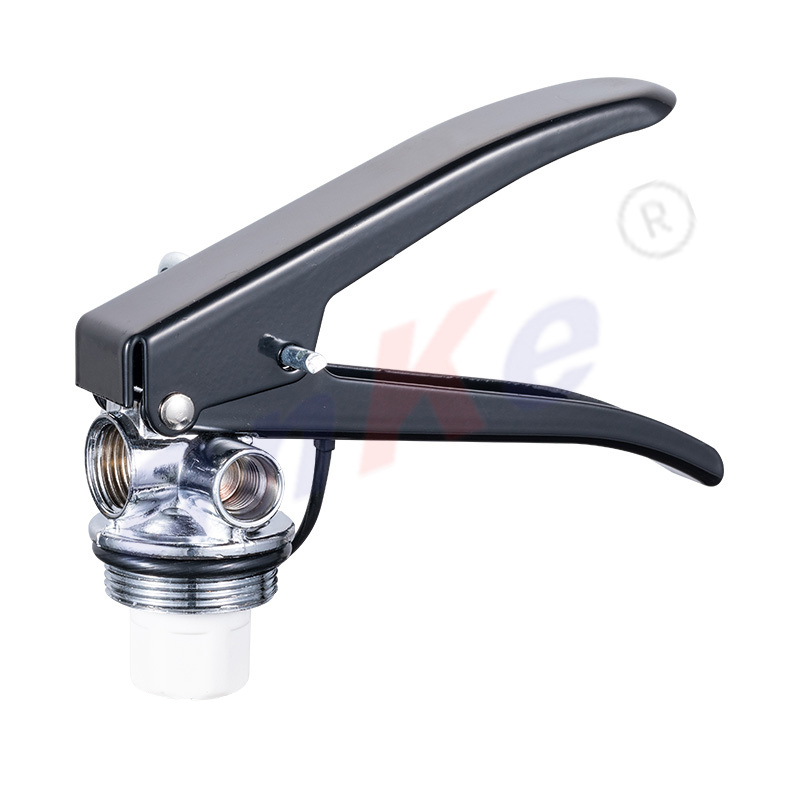
- Valve assembly - body, stem, spring, seat, seals, gauge port, relief device and discharge outlet.
An ABC multi-purpose unit makes the naming concrete. Its agent is monoammonium phosphate, a finely ground powder that looks like pale yellow talcum powder and is treated with silicone so it keeps flowing instead of packing into a solid block during transport. The number on the label - 1 kg, 2 kg, 4 kg, 9 kg, 12 kg - is the agent weight, not the weight of the finished appliance. A complete 4 kg dry powder extinguisher, once the cylinder shell, brass valve, hose, horn, bracket and label are added, usually tips the scales somewhere between 7.5 and 9 kg. Freight quotes built on "4 kg multiplied by 500 pieces" always come back short once the pallet is weighed at the port.
Search behaviour around this question shows a second layer of confusion. People also ask what the gas inside a fire extinguisher is called (the propellant, normally nitrogen), what the tube inside is called (the siphon tube, sometimes translated as dip tube or pick-up tube) and what the whole top section is called (the valve assembly). Each of those three parts has its own specification, its own failure mode and its own replacement interval, which is why a single line on a purchase order is rarely enough to describe what is actually inside a cylinder.
The Substance Inside: Agent, Medium, Charge and Propellant
Four words get used almost interchangeably in the trade, and each one means something slightly different. Sorting them out before a specification sheet is written saves a full round of samples and a week of emails.
| Term | What it refers to | Where you meet it |
|---|---|---|
| Extinguishing agent | The powder, liquid, foam or gas that interrupts combustion | Agent label, safety data sheet, extinguisher body marking |
| Extinguishant | The same substance, described in standards language and translations | Test reports, conformity documents, translated tender files |
| Charge | Shop-floor word for the filled agent weight, and also for the gas pressure charge | Works orders, service records, refill invoices |
| Propellant | Nitrogen or carbon dioxide that expels the agent, and does not extinguish anything itself | Valve specification, gauge design, cartridge selection |
| Fill weight | Mass of agent in the cylinder, which equals the nominal size of the unit | Packing list, label, quality control record |
| Headspace | The gas volume above the agent bed where the pressure lives | Filling calculations, pressure test setup |
| Gross weight | Mass of the complete charged unit including valve, hose and bracket | Freight, customs, shelving and bracket rating |
The distinction between stored-pressure and cartridge-operated units belongs here as well, because it changes what is physically inside the cylinder. In a stored-pressure extinguisher, the agent and the nitrogen propellant share the same space. The cylinder is charged through the valve to its working pressure and the gauge shows that pressure at every moment of the unit's life. In a cartridge-operated extinguisher, the cylinder holds the agent at atmospheric pressure and a small CO2 cartridge sits inside or alongside the valve. Pressing the lever drives a puncture pin into the cartridge, gas floods the cylinder, and the agent is expelled. Nothing at all happens until that pin moves, which is why a cartridge-operated unit has no meaningful pressure reading before discharge.
Cartridge types dominate larger wheeled and trolley units and show up frequently in markets where long storage life matters, because the agent is not sitting under pressure for years. Stored-pressure types dominate portable sizes and are simpler to service, but they depend entirely on a permanent seal holding for the whole service interval. Both designs put the same three things inside the cylinder: the agent, a gas volume, and a tube that reaches down toward the base.
From Cap to Base Ring: What Sits Inside a Stored-Pressure Unit
Take a stored-pressure dry powder extinguisher apart from the top down and the list of internal parts turns out to be longer than most people expect. It is worth knowing the list, because the parts that fail are almost never the ones people suspect when a complaint comes in.
| Internal part | Job it does | Common materials | What to check |
|---|---|---|---|
| Safety pin and tamper seal | Locks the lever until the unit is needed | Steel wire, plastic seal | Pin bent, seal missing or replaced with string |
| Lever or squeeze grip | Transfers hand force to the valve stem | Steel, aluminium, engineering plastic | Cracking at the pivot, excessive free travel |
| Valve stem and spring | Opens and reseats the sealing disc | Brass, stainless steel, spring steel | Spring set, stem scoring, sticking after long storage |
| Seat and seals | Hold nitrogen and agent inside for years | NBR, EPDM, PTFE, silicone | Swell, hardening, extrusion, compression set |
| Pressure gauge | Displays headspace pressure, not agent quantity | Brass body, glass or polycarbonate lens | Stuck pointer, fogged lens, zero reading |
| Fill port or charging valve | Allows nitrogen charging and agent top-up | Brass, stainless steel | Leak after charging, damaged thread |
| Nitrogen headspace | Stores the energy that expels the agent | Nitrogen, a few grams per unit | Slow loss, wrong charging pressure |
| Siphon tube | Draws agent from the base of the cylinder to the valve | PVC, PP, nylon, copper, stainless steel | Cut length, contact with cylinder base, cracking |
| Agent bed | Provides the extinguishing action | Powder, water, foam premix, wet chemical | Moisture, caking, fill weight tolerance |
| Cylinder shell and base ring | Holds pressure and protects the base weld | Steel, stainless steel, aluminium | External corrosion, dented base, coating damage |
The siphon tube deserves a paragraph of its own. It is a rigid or semi-rigid tube, usually plastic or metal, threaded or pressed into the valve inlet and cut to a length that stops a few millimetres above the inside surface of the cylinder base. If the tube is too short, powder remains in the bottom of the cylinder after discharge and the rated fire performance cannot be met. If it is too long and touches the base, the cut end can seal against the cylinder floor under discharge pressure. A cut-length tolerance of roughly plus or minus two millimetres is normal in production, and that tolerance is verified with a depth gauge rather than by eye. Our own range of siphon tube assemblies is specified by cylinder volume and valve model rather than by extinguisher size alone, because two 6 kg cylinders produced on different tooling can differ in internal depth by more than the tolerance itself.
The nitrogen headspace is the part that cannot be seen at all. The gas occupies the space above the agent bed, and its pressure is what the gauge displays. In a 4 kg unit charged to about 1.4 MPa, which is 14 bar, the mass of nitrogen involved is only a few grams. That single fact explains a great deal of field behaviour. A slow leak that loses one gram of nitrogen takes months to appear as needle creep, and a gauge that has moved two divisions since the last service is a far stronger signal than a gauge sitting on the edge of the green band. It also explains why top-up servicing is delicate work: adding nitrogen is easy, adding the correct amount of nitrogen is the part that requires a calibrated charging rig.
What the Agent Is Called in Each Extinguisher Family
The word "agent" only becomes useful once it is attached to a family. Six families cover almost every portable extinguisher sold into international markets, and each one has a chemical name that should appear consistently on the label, the safety data sheet and the customs paperwork.
| Family | Chemical name of the agent | Fire classes | What you see inside | Internals note |
|---|---|---|---|---|
| ABC dry chemical | Monoammonium phosphate, silicone treated | A, B, C | Pale yellow powder, flows like flour | Valve seat and tube must clear a fine, slightly abrasive powder |
| BC dry chemical | Sodium bicarbonate or potassium bicarbonate | B, C | White powder, often with anti-caking additives | Chosen where residue on Class A risks is unacceptable |
| Carbon dioxide | CO2, stored as a liquid under its own vapour pressure | B, C, electrical | Liquid that flashes to gas and dry ice particles | Short dip tube, bursting disc, usually no gauge |
| Water and water mist | Water, sometimes with antifreeze or an additive | A | Clear liquid | Heavier fill, corrosion-resistant wetted parts essential |
| Foam | AFFF or ARAFFF concentrate premixed with water | A, B | Coloured liquid that foams on impact | Concentrate ratio must be exact or the foam collapses |
| Wet chemical | Potassium acetate or potassium citrate solution | A, K | Pale alkaline liquid | Saponifies cooking oil; needs stainless wetted parts |
| Clean agent | HFC-227ea or FK-5-1-12 | A, B, C | Liquid that vaporises on release | No residue; used around electronics and archives |
| Class D dry powder | Sodium chloride or graphite-based compounds | D | Coarse white or grey powder | Applied with a soft, low-velocity stream; never used on other classes |
Two practical rules follow from that table. First, the agent determines the material of everything it touches. An alkaline wet chemical agent will attack a plain brass valve body over a storage life measured in years, so wet chemical units use stainless steel bodies, plated stems and EPDM or PTFE seals. Dry powder is abrasive and mildly hygroscopic, so the valve seat has to seal against a solid rather than against a clean liquid. Carbon dioxide dissolves into many elastomers under pressure and then decompresses violently, so seals must be selected for rapid gas decompression behaviour rather than for hardness alone.
Second, agent weight is not interchangeable between families. One litre of water weighs close to 1 kg, one litre of foam premix is similar, and one litre of ABC powder weighs roughly 0.9 kg depending on bulk density and aeration. A cylinder rated at 9 litres does not automatically become a 9 kg powder unit. Bulk density of the powder batch and fill height both belong in the purchase specification, otherwise the first shipment and the fifth shipment can end up performing differently on the same fire test.
The Valve Assembly: Where Most Naming Errors Start
Ask ten people what the top of an extinguisher is called and you will hear handle, head, cap, fitting and mechanism. The accurate name is the valve assembly, and inside it sit more small parts than in the rest of the extinguisher put together.
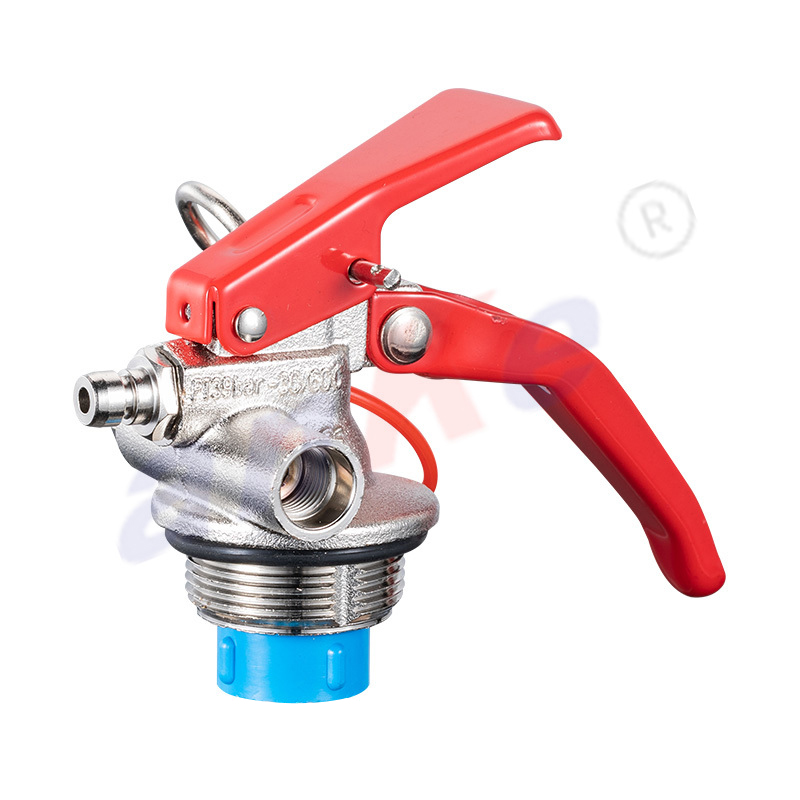
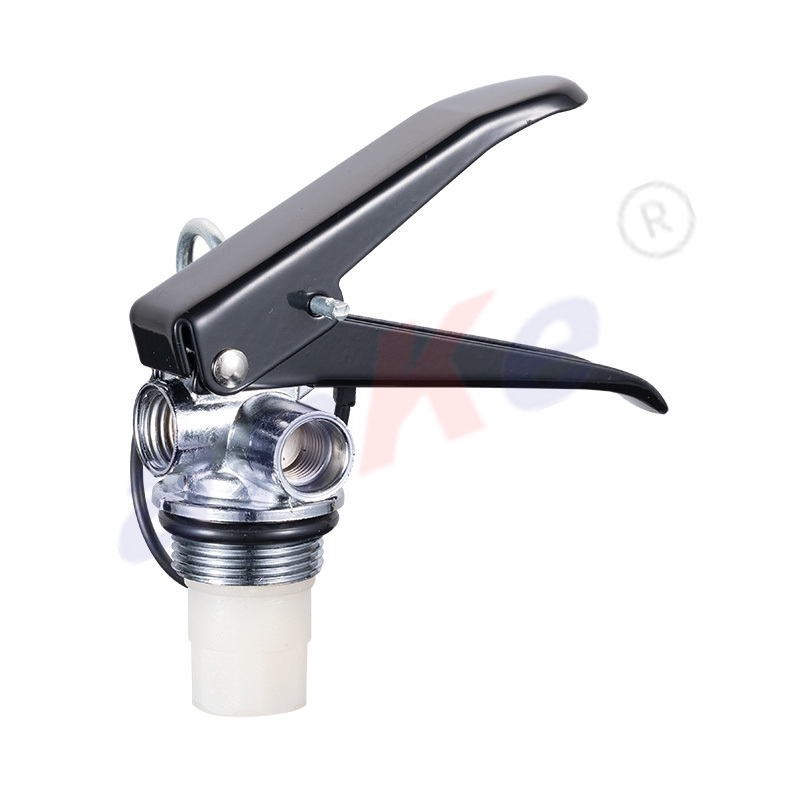
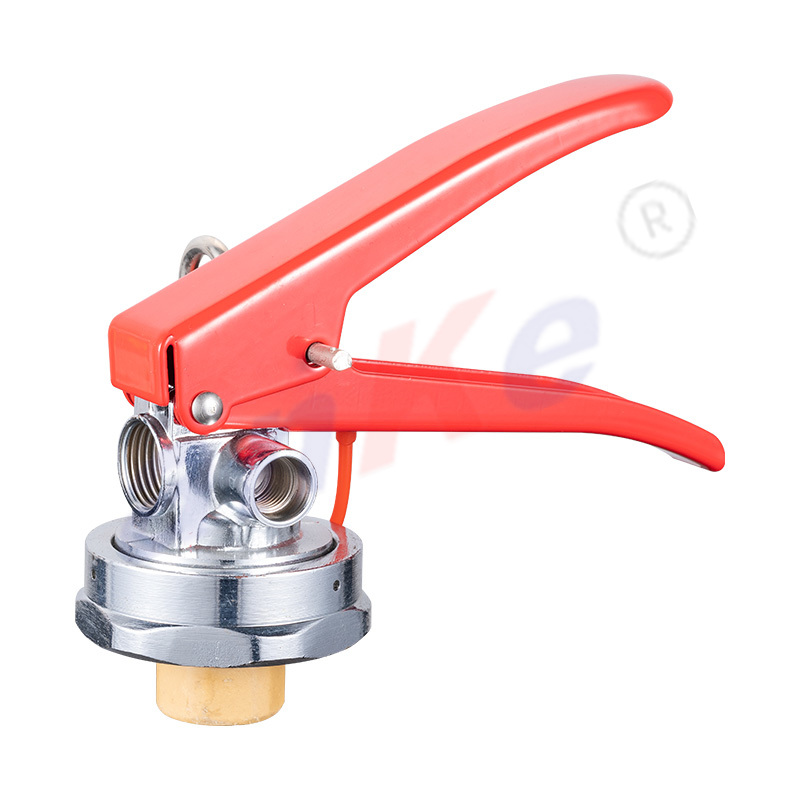
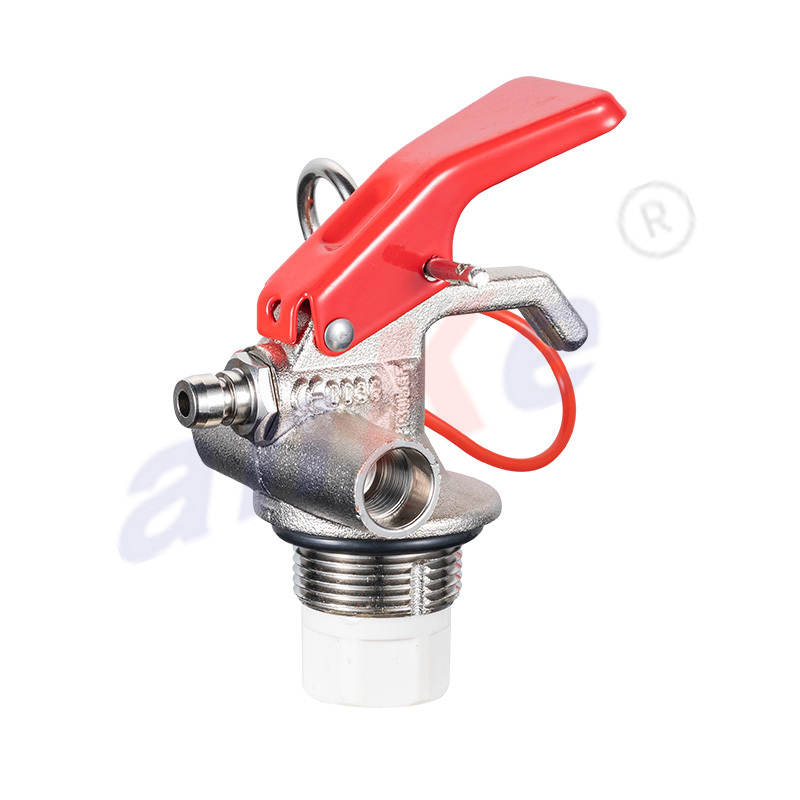
Working down through it: the lever or squeeze grip presses on the valve stem; the stem is held closed by a spring; a seat, usually a rubber or PTFE disc, closes against the valve body orifice; a safety pin and tamper seal lock the lever at rest; a pressure gauge or a plugged gauge port sits on one side; the discharge outlet accepts the hose, horn or nozzle; and on some models an internal relief device vents if the cylinder is overfilled or overheated. On CO2 valves the relief device is a bursting disc rather than a reseating valve, because once liquid carbon dioxide has expanded there is no way to close the vent again.
Materials follow the agent. Brass bodies dominate dry powder and water units worldwide, aluminium bodies are chosen where weight matters, and stainless steel is standard for wet chemical duty and for many marine-approved products. Seal compounds are selected by agent rather than by price: NBR for general dry powder and water service, EPDM for carbon dioxide and water-based agents, PTFE for aggressive chemistry and high temperature, and silicone where very low temperature operation is expected. A valve that is chemically correct but thermally wrong will pass every pressure test in a warm factory in July and leak in an unheated warehouse in January.
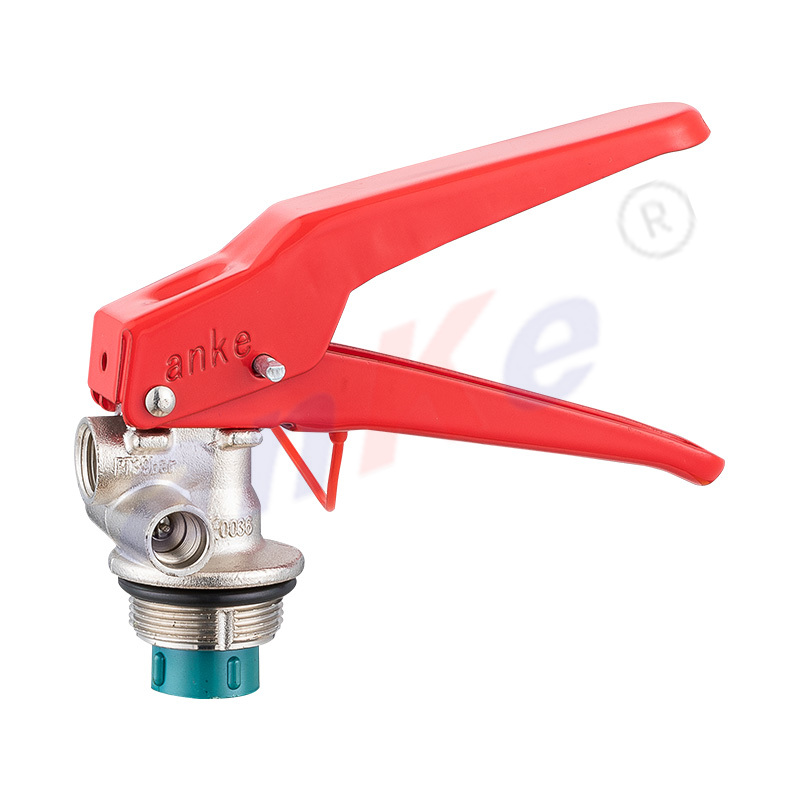 4–12 kg Dry Powder Fire Extinguisher Valve 1001For 4–12 kg stored-pressure dry powder extinguishers, this brass or aluminum valve includes NBR/PTFE seals, optional gauge and 24±2 BAR relief.View Product →
The tolerance that matters most on a valve assembly is not the thread, it is seat concentricity. A stem sitting half a tenth of a millimetre off centre will still hold on the bench and will still pass a short bubble test, but it will not hold for five years against a powder that never fully stops moving during transport. Buyers who request seat concentricity data, spring load data and a 24-hour pressure hold record receive far fewer winter complaints than buyers who approve a sample by eye on a Friday afternoon. Torque values belong in the same conversation: under-torqued valve-to-cylinder joints leak, over-torqued joints crack necks and damage the very seat the design depends on.
Our dry powder and water valve range covers 1 kg through 12 kg cylinder necks in stored-pressure and cartridge versions, with brass, copper-plated and stainless options, supplied with seal sets matched to the agent that will be filled. Matching a valve to an agent after the fact is where most compatibility problems begin.
Inside a CO2 Extinguisher: Liquid, Snow and a Bursting Disc
A carbon dioxide extinguisher has an interior that behaves unlike any powder unit. The agent is the propellant. Liquid CO2 sits in the cylinder under its own vapour pressure, approximately 5.7 MPa, which is about 830 psi, at 20 °C. There is no nitrogen headspace, and most portable models carry no pressure gauge at all.
CO2 cylinder pressure changes sharply with temperature
Values are approximate vapour pressures for a properly filled cylinder, shown to illustrate why CO2 units are checked by weight and not by gauge.
Inside the cylinder a short dip tube reaches toward the bottom, so that liquid rather than vapour is drawn off when the valve opens. The liquid passes the valve, expands through a small orifice and turns into a mixture of gas and fine dry ice particles. That expansion is the reason the horn exists at all: the discharge leaves the valve at very high velocity, and a bare outlet would scatter the stream instead of directing it. The horn also lets the expanding gas slow down and warm slightly, and it is the reason CO2 horns are replaced as spare parts rather than repaired after a knock.
Two internal features separate CO2 from everything else. First, the safety device is a bursting disc, sized to release well above normal storage pressure but below the cylinder test pressure, and a disc replaced with a wrong-rated part is worse than no service at all. Second, the seals are exposed to a fluid that swells and then decompresses elastomers quickly, so the compound and the extrusion gap around the seat matter more than the nominal hardness number.
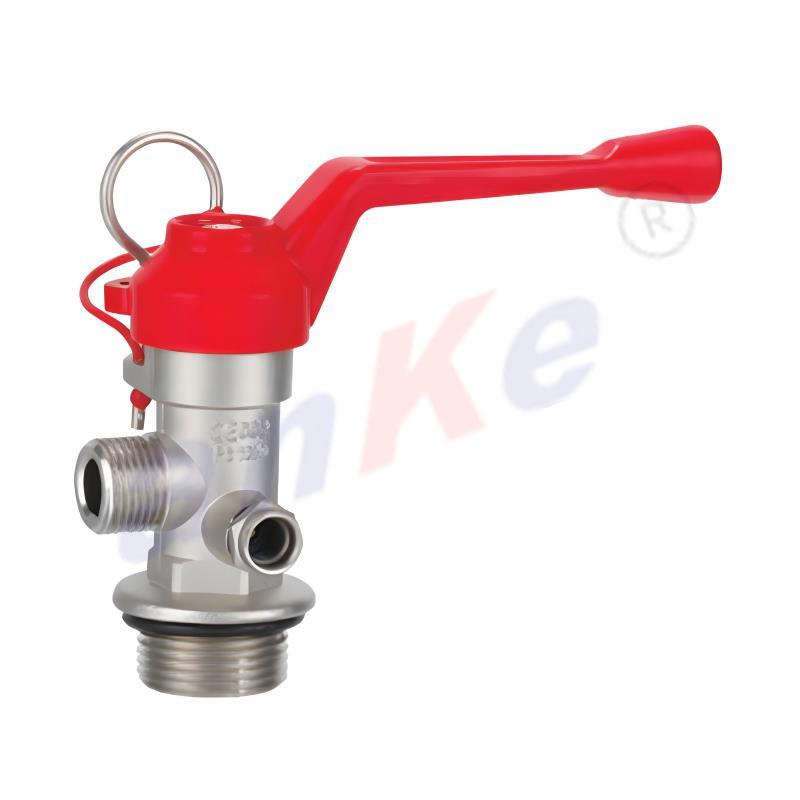
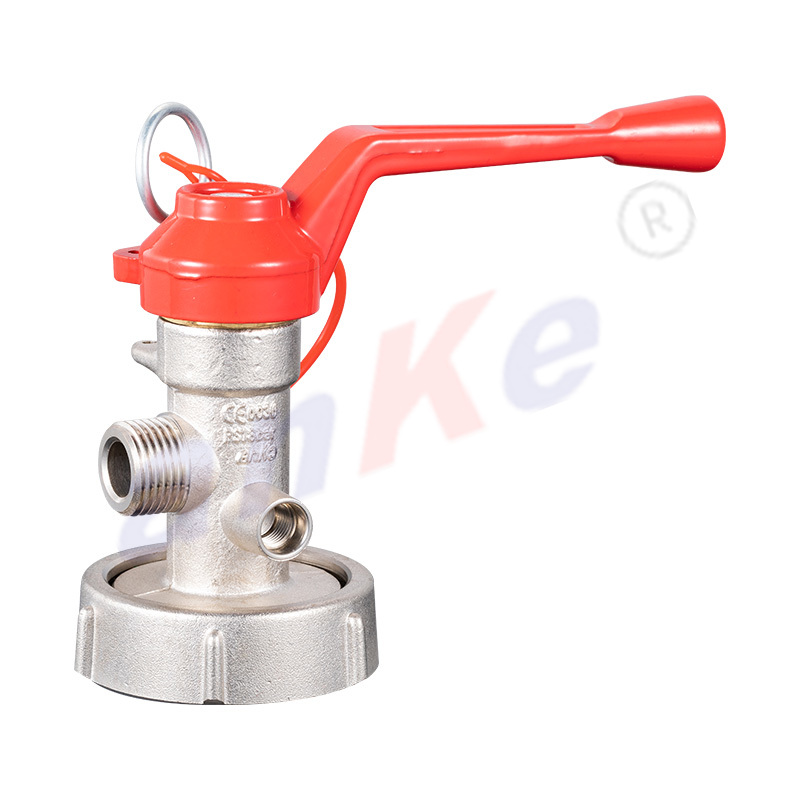
Because there is no pressure gauge, the interior is checked by weight. A 5 kg CO2 extinguisher that has lost 250 g of charge has lost a significant share of its capacity and shows nothing on the outside. That single fact is the strongest argument for a monthly weigh check in any facility where CO2 units are the primary protection. Our CO2 valve range covers 2 kg to 9 kg portable cylinders in brass, copper and stainless steel, with CE and US-style neck threads, red or stainless handles and matched bursting discs.
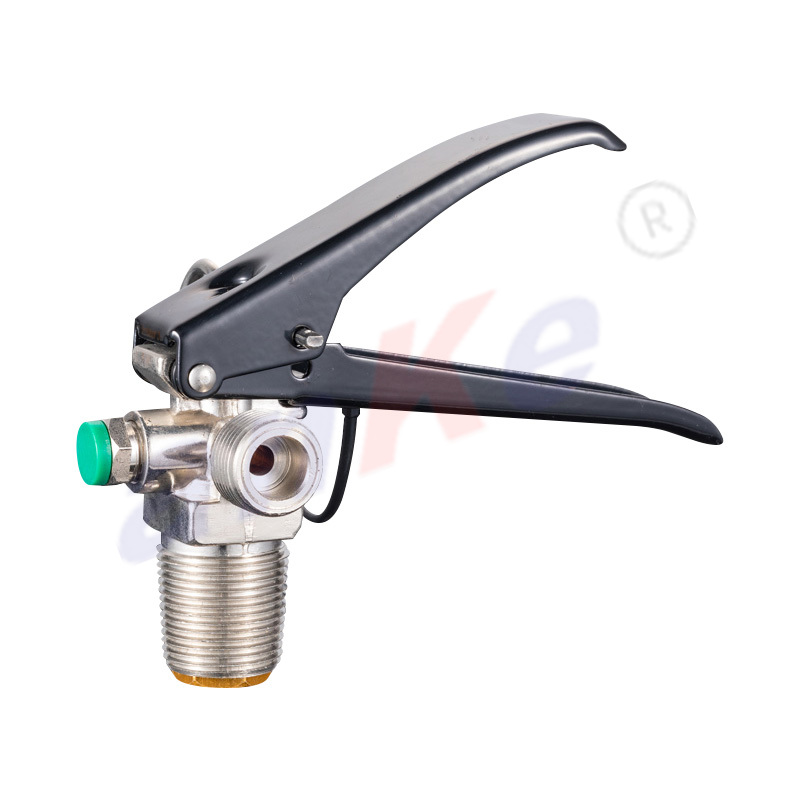 2–9 kg CO₂ Fire Extinguisher Copper Valve 2005For 2–9 kg CO₂ extinguishers, this copper valve has PZ27.8 neck, W21.8 outlet, M10x1 siphon thread and 200±15 BAR relief.View Product →
Pressure Behaviour: Reading the Inside Through the Gauge
A pressure gauge does not measure how much agent is left. It measures the pressure of the nitrogen in the headspace, and that pressure moves with temperature every hour of every day. For a nitrogen-charged stored-pressure unit, the change is roughly 0.5 to 0.6 bar for every 10 °C shift, and it is predictable enough that a service technician can calculate what a reading should be at a given temperature instead of condemning a cylinder that has simply spent the night in a cold store.
Gauge reading of a unit charged to 15 bar at 20 °C
Calculated from absolute temperature with a fixed gas mass, which is why a low winter reading is normal and a summer reading can sit near the top of the green band.
Green bands are set by the manufacturer to bracket the acceptable working range, commonly in the region of 12 to 18 bar on many CE-marked dry powder models and around 195 psi, which is 13.4 bar, on many US-style units. A needle sitting just below the green at minus 10 °C in an unheated warehouse is not a defect. A needle sitting in the middle of the green on a warm afternoon, in a unit that sat at the bottom of the green twelve months earlier, is genuine nitrogen loss and needs attention.
Mechanical faults look similar but are not the same thing. A pointer that sticks, a lens that has fogged from the inside, and a bourdon tube that has taken a knock all produce readings that do not match actual pressure. Before replacing a cylinder, a technician should compare the gauge reading against a calibrated test gauge fitted to the valve, and confirm the pointer moves freely across its whole travel. A stuck pointer is a gauge replacement. A genuinely low reading is a cylinder and seal problem, and swapping gauges will not fix it.
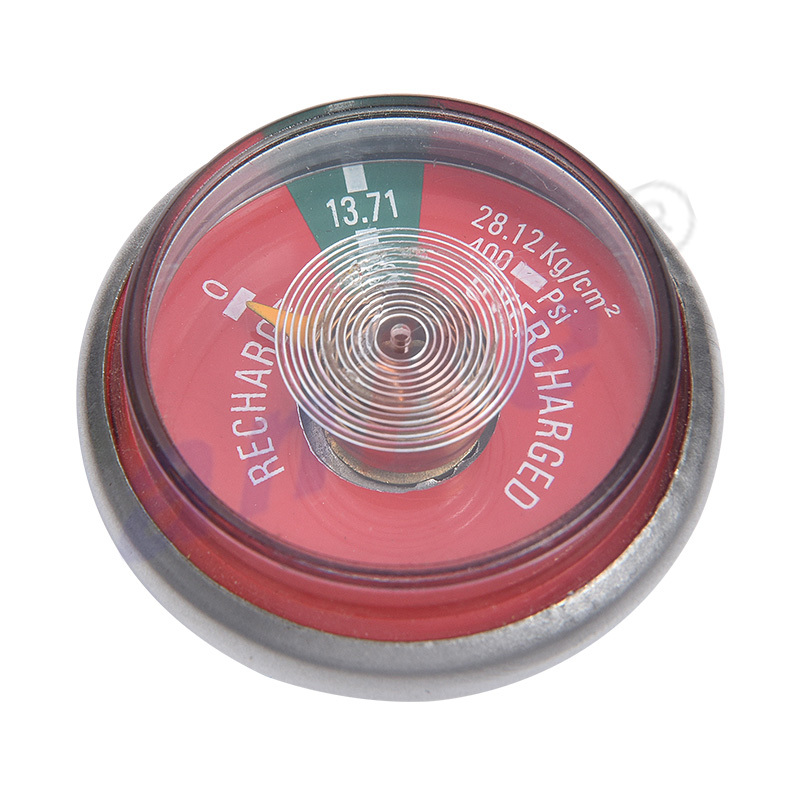 Fire Extinguisher Pressure Gauges for Stored-Pressure UnitsCompare Bourdon-tube gauges for dry powder, water, foam, industrial and marine use, with green operating zones and thread options; CO₂ extinguishers do not use gauges.View Product →
How the Inside Fails: Caking, Corrosion and Seal Ageing
Field returns rarely arrive with a dramatic story. Most internal failures are slow, invisible and entirely predictable, which is good news for anyone writing a specification, because every one of them can be designed around.
Powder caking
Moisture entering through the valve seal, or condensation from repeated temperature cycling, fuses powder into lumps that will not fluidise. Silicone treatment and anti-caking additives delay the process. They do not make a leaking seal acceptable.
Seal hardening
Heat ages NBR and EPDM. A unit stored near a south-facing window or in an engine bay can harden a seat within two or three years and begin a slow nitrogen loss long before the annual check.
Seat contamination
One grain of powder trapped between seat and orifice cuts a channel that no amount of re-torquing will close. It usually happens during filling, when a valve is fitted with powder left on the thread.
Corrosion of wetted parts
Water-based agents with untreated antifreeze, or an alkaline wet chemical agent sitting against a brass body, produce pitting along the dip tube and around the cylinder base weld over years of storage.
Tube misalignment
Over-length tubes bent during assembly, or tubes that touch the cylinder base, restrict flow. A partial blockage shows up as a shorter discharge time and a fire rating the unit no longer earns.
Bursting disc fatigue
A CO2 disc cycled through years of hot and cold can release early. A disc replaced with the wrong pressure rating is a far worse outcome than a disc that was left alone.
Condensation deserves a specific mention because it is the failure mode that surprises importers most often. A cylinder filled in a humid season, sealed warm, and then shipped through a cold route will pull moisture into any void the seal allows. Powder that was free-flowing at the factory gate can be lumpy six months later without a single mechanical defect. This is why filling halls are humidity controlled, why powder is stored sealed until the moment of filling, and why a pressure hold record matters more than a visual inspection in a finished goods warehouse.
Verification Before the Valve Is Torqued Down
A factory that treats internal quality as a checklist of tests, rather than a single pressure test at the end, will produce cylinders that behave the same way in the fifth year as in the first month. The sequence below is the one that matters most for stored-pressure and cartridge-operated products.
- Incoming material certification for brass, aluminium and stainless components, including chemistry and hardness where the stem or spring depends on it.
- Cleaning and drying of every wetted part. Alkaline wet chemical agents require passivation, and residual machining oil is a guaranteed future seat failure.
- Seal compatibility soak, with seals held in the actual agent at elevated temperature for several days and then measured for swell, hardness change and compression set.
- Cylinder proof testing at a multiple of working pressure, defined by the regional standard, plus an internal inspection before any powder is introduced.
- Valve leak testing in a water bath at working pressure, with the valve both closed and fully open, so the stem seal and the seat seal are each verified separately.
- Siphon tube cut-length verification against the drawing tolerance, with depth gauge records kept by batch.
- Fill weight verification within plus or minus two percent of nominal, with bulk density recorded for each powder lot.
- A 24-hour pressure hold after charging, followed by a final gauge reading and a leak check at the gauge port and fill port.
- Torque records and batch traceability, so that a complaint in year three can be traced back to a seal lot, a powder lot and a specific shift.
Design and test requirements are set regionally. The EN 3 series applies across Europe, UL 299 and UL 711 apply in North America, ISO 7165 is used internationally, and AS/NZS 1841 applies in Australia and New Zealand. A factory running one production line for all four markets has to keep four sets of test records, and an importer buying from a factory that cannot produce them is buying a promise rather than a product. Certifications such as CE, ISO, TUV, MPA and BSI are only meaningful when the underlying test data can be shown for the exact model being shipped, not for a similar model from an earlier year.
Specification Checklist for Buyers and Engineers
Nine lines on a specification sheet prevent most of the problems described above. They take ten minutes to write and they are worth a full container of avoided returns.
- Agent family and chemical name, not just the fire class.
- Agent fill weight with tolerance, plus bulk density range for powders.
- Propellant type and working pressure at 20 °C, with the acceptable temperature operating range.
- Seal compound by name, with the agent compatibility test report attached.
- Valve body and stem material, including plating specification where corrosion resistance is claimed.
- Siphon tube material, inner diameter and cut length, referenced to the cylinder drawing.
- Gauge range, green band limits and whether a gauge is required at all for CO2 models.
- Service and spare strategy, covering seals, dip tubes, gauges and hoses for the expected unit life.
- Label, safety data sheet and shipping documentation in the destination language, including the correct transport classification.
The shipping point is frequently overlooked. Many authorities classify a charged extinguisher under UN 1044 for compressed or liquefied gas, while certain liquid charges shipped separately fall under UN 1774 for corrosive extinguisher charges. Getting that classification wrong delays a container for weeks, and it is not something a forwarder will correct on the buyer's behalf.
Matching the Inside to the Application
Agent choice follows the fire risk, not the price list. Where two agents both carry the right classification, the decision usually turns on residue, temperature exposure or the material of the surrounding equipment.
- Vehicle engine bays and cabs: 1 kg to 2 kg stored-pressure ABC powder with a high-temperature seal and a bracket rated for vibration.
- Commercial kitchens and food preparation lines: wet chemical units with stainless steel wetted parts, since the agent must saponify hot cooking oil and remain stable for years in an alkaline state.
- Electrical switch rooms and control cabinets: CO2 or clean agent, because neither leaves residue on terminals or circuit boards.
- Warehouses, workshops and loading areas: 6 kg to 12 kg dry powder or foam, where the priority is fast knockdown over clean-up.
- Metalworking and machining: Class D powder matched to the specific metal, applied with a low-velocity nozzle and never used on surrounding Class A material.
- Marine and offshore duty: marine-approved ABC units with corrosion-resistant brackets and plated valve bodies.
- Server rooms, archives and museums: clean agent units or fixed systems, where discharge must not damage the contents.
- Homes and small offices: 1 kg to 2 kg ABC powder or a 2 kg CO2 unit, chosen for ease of handling by an untrained user.
Kitchen protection is the clearest case where the internals must match the risk precisely. A powder unit discharged onto a deep fat fryer can splash burning oil and, in laboratory conditions, has been shown to worsen an already dangerous situation. Class K wet chemical extinguishers solve this by reacting with the oil rather than smothering it from above, which is exactly why the wetted path of a wet chemical unit is specified in stainless steel and its seals are chosen for alkaline service rather than for cost.
Spares, Refills and the Lifetime of the Internals
Inside a fire extinguisher, the agent and the hardware age at completely different rates. Powder, foam concentrate and wet chemical solution are consumables. The valve assembly, siphon tube and cylinder are durable parts whose service life depends on storage conditions, water exposure and how many times they have been opened.
Service practice varies by market, but a common pattern runs like this. A monthly visual check by the owner covers the gauge reading, the safety pin, the tamper seal and obvious corrosion. An annual professional inspection covers weight, pressure, hose condition and a functional check of the lever. Dry powder units in several markets are discharged and refilled on a five-year cycle, because powder can compact even in a sound cylinder, and the first hydraulic test of the cylinder often lands around the ten-year mark. Always confirm the schedule against the standard that applies where the unit is installed, because these intervals are set locally and are not interchangeable between regions.
Refilling introduces a question that deserves a direct answer. If a cylinder comes in for a five-year agent change and goes out with the original valve, the original seals, the original gauge and the original siphon tube, the buyer has paid for new powder on old hardware. The next failure will arrive within two years, and the agent will be blamed for it. A proper refill service replaces the seat, the stem seals, the gauge O-ring and any tube showing hardening or deformation, and it re-checks the bursting disc on CO2 units. That is a different price point, and it is the only version that delivers a genuinely renewed five-year interval.
Frequently Asked Questions About Fire Extinguisher Interiors
Is the inside of a fire extinguisher a liquid or a powder?
It depends on the family. Dry chemical, dry powder and Class D units hold powder. Water, foam, wet chemical and clean agent units hold liquid. Carbon dioxide units hold liquid CO2 that flashes into gas and dry ice particles the moment it leaves the valve. The one thing every type has in common is a pressurised gas volume above or inside the agent.
What is the gas inside a fire extinguisher called?
In stored-pressure models it is nitrogen, acting as the propellant rather than as an extinguishing agent. In cartridge-operated models it is carbon dioxide released from a small sealed cartridge when the puncture pin fires. In CO2 extinguishers the carbon dioxide is both the agent and the source of pressure.
What is the tube inside a fire extinguisher called?
It is the siphon tube, also written as dip tube or pick-up tube. It runs from the valve inlet down to just above the base of the cylinder so that agent can be drawn out even when the cylinder is nearly empty. Its cut length is tolerance-controlled, because a tube that is too short leaves agent behind and a tube that is too long can seal against the cylinder base.
Why does a fire extinguisher lose pressure over time?
Nitrogen escapes through the smallest available path, usually a valve seat or a stem seal that has hardened, contaminated or compressed permanently. Temperature swings can mask it: a unit can read normally on a warm day and sit low on a cold morning. A reading that drifts downward across two or three annual checks is the reliable sign, not a single reading taken at one temperature.
Do CO2 extinguishers have a pressure gauge?
Most portable CO2 models do not, because the cylinder pressure is simply the vapour pressure of the liquid and it stays high until the last of the liquid has gone. Capacity is verified by weighing the cylinder and comparing it with the stamped full weight. A missing gauge is normal, not a manufacturing fault.
What is inside a water extinguisher?
Water, sometimes with an antifreeze additive or a wetting agent, plus a nitrogen headspace for stored-pressure models. The interior hardware is similar to a dry powder unit but with heavier requirements on corrosion protection, since water and low-grade steel are a poor combination over a multi-year service life.
Can a fire extinguisher be refilled at home?
No. Refilling requires the agent weight to be measured, the cylinder to be charged with a controlled amount of nitrogen, and the valve to be leak tested under pressure. None of that can be judged by feel or by watching a gauge briefly. A refill that is visually complete but undercharged will fail exactly when it is needed.
Next Step: Send the Agent, the Pressure and the Neck Size
If you are sourcing extinguisher valves, CO2 horn assemblies, siphon tubes or complete units, three pieces of information speed up a quotation more than anything else: the agent family and fill weight, the required working pressure and temperature range, and the cylinder neck thread. With those three details, a valve can be matched to the agent, the seal compound can be matched to the temperature exposure, and the siphon tube can be cut to a length that actually reaches the base of your cylinder.
Ningbo Kaituo Valve Co., Ltd, also known as Ningbo Anke Fire Equipment Co., Ltd, has been manufacturing fire equipment under the anke brand since 2001, with CE, ISO, TUV, MPA and BSI certification marks and a product line that runs from extinguisher valves and pressure gauges through hoses, horns, cabinets, sprinklers and system valves. Samples, seal compatibility data and valve drawing files are available on request, and the technical team can be reached directly on WhatsApp through the number on the contact page when a specification needs to be settled quickly rather than by email chain.
 Phone: +86-13456107058/+86-15967800709
 Tel: +86-574-62010128/+86-574-62010688
 E-mail:
  Factory: Huilong Village, Huangjiabu Town, YuyaoCity,Zhejiang Province, China





 Domestic Trade Manager
 Foreign Trade Manager
 VR Catalogue
