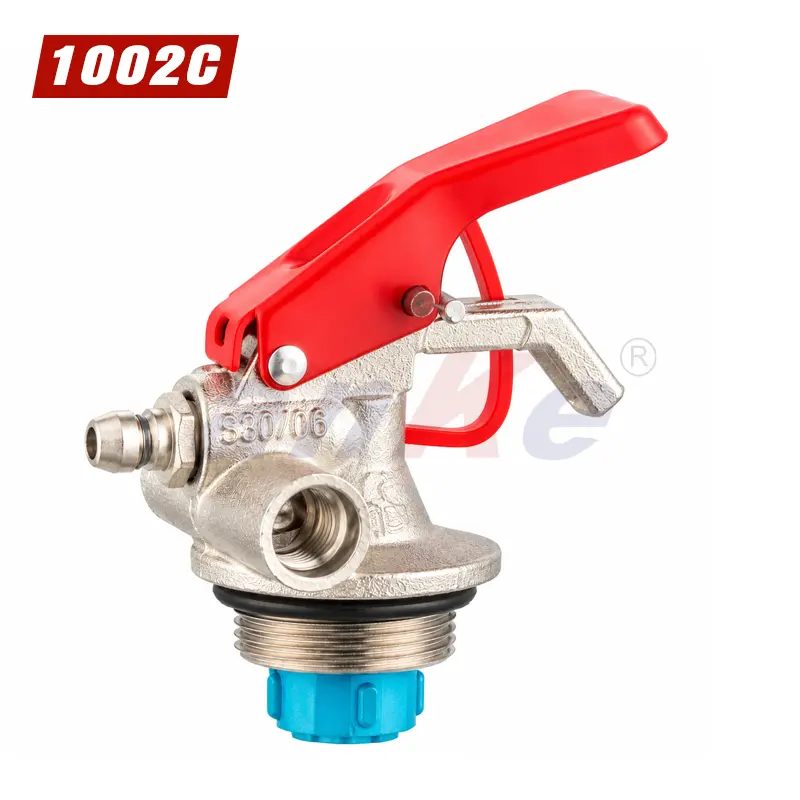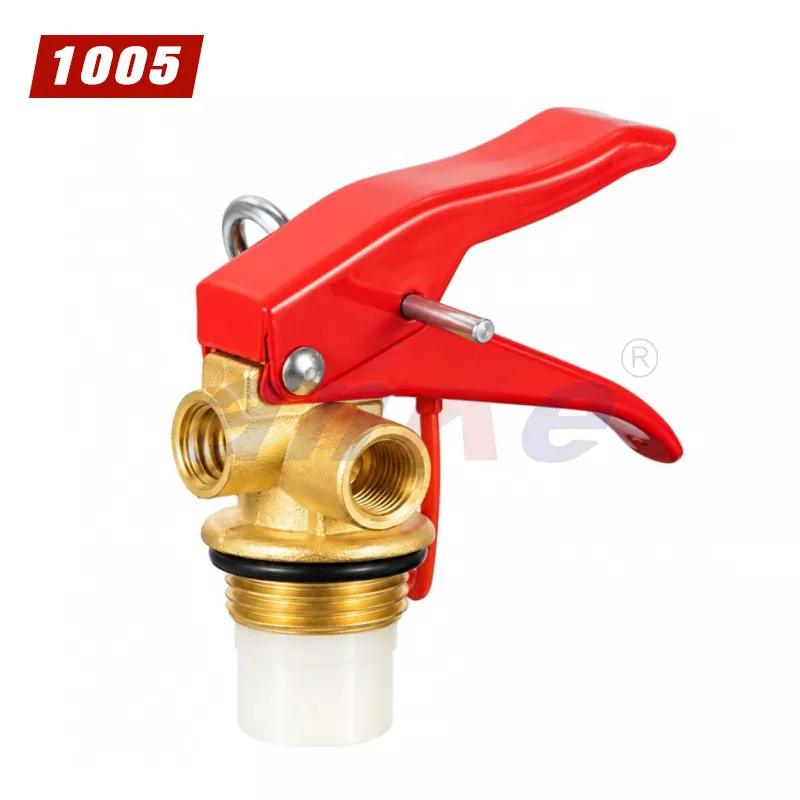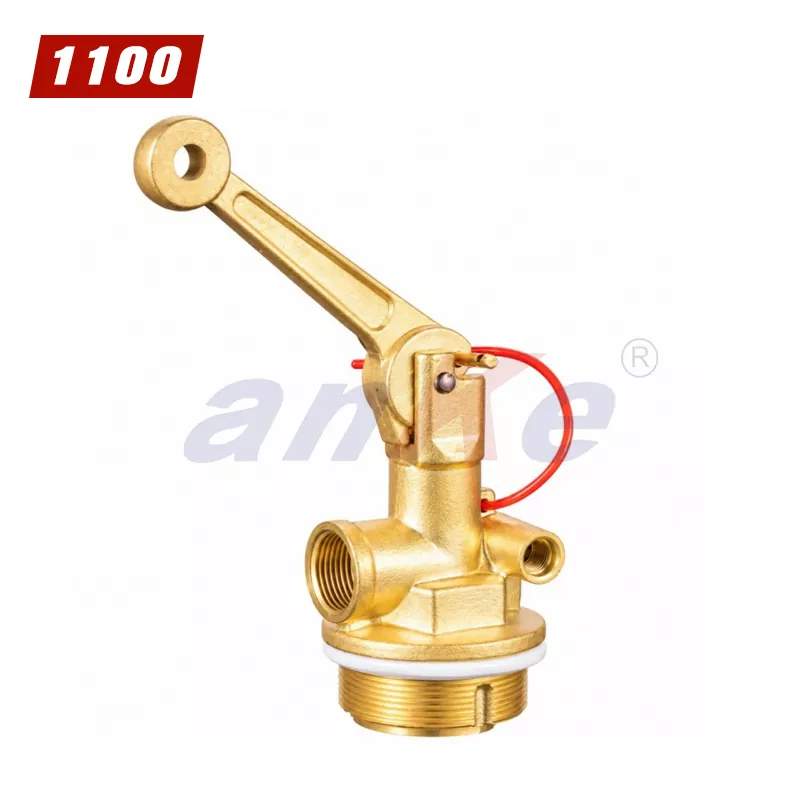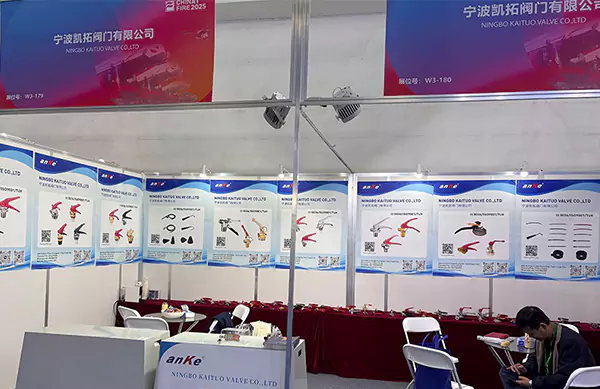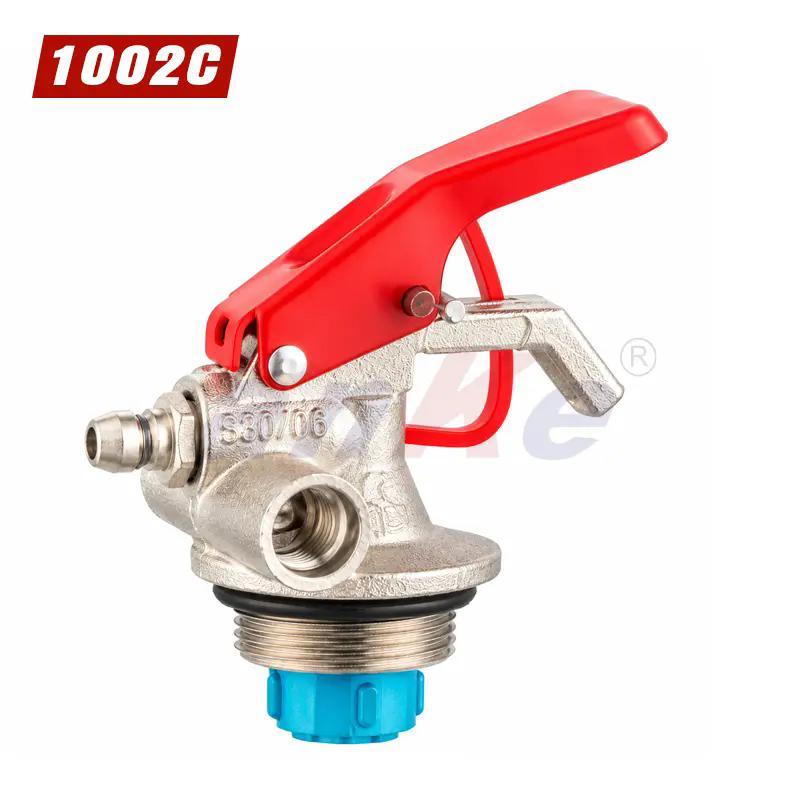
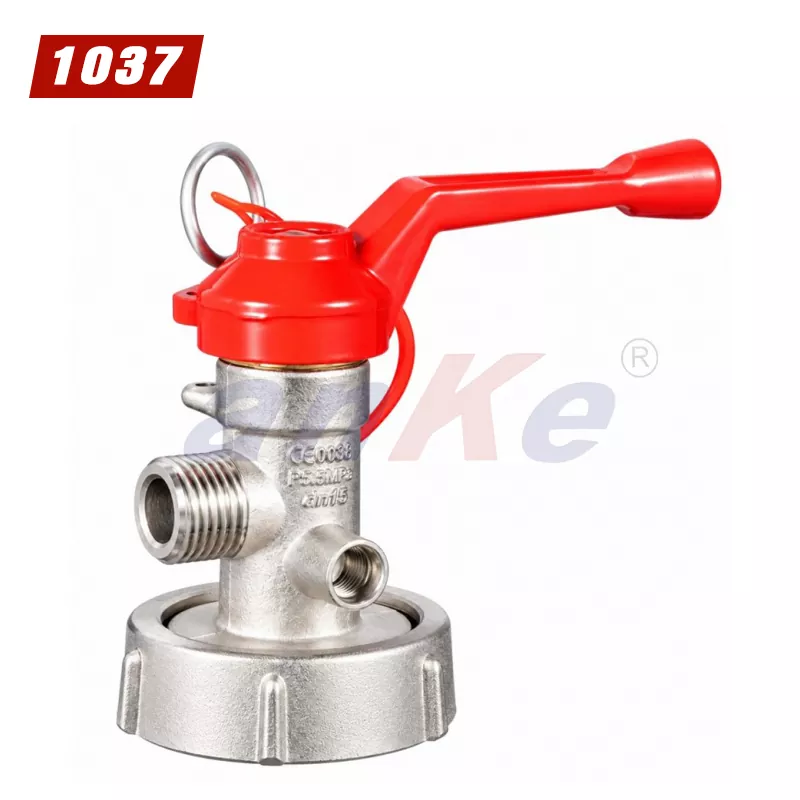
Ningbo Kaituo Valve Co., Ltd. (Brand: ANKE) is your dependable Chinese manufacturing partner, specializing in premium fire safety valves and components.The 25-50KG fire extinguisher copper alloy valve precise pressure control function ensures that the appropriate amount of extinguishing agent is released when the fire extinguisher is activated to deal with fires of different sizes and types. At the same time, the valve is made of corrosion-resistant materials to ensure long-term stable operation in corrosive environments related to liquid fires. Its quick-start mechanism allows it to respond immediately when a fire occurs and release the extinguishing agent quickly, thereby minimizing the damage caused by the fire.
| Item | Specification |
|---|---|
| Material | copper alloy |
| surface treatment | According to customer requirements (chrome plating/nickel plating) |
| Bottle mouth thread | G1”/M30*1.5 |
| Exit thread | G1/2 |
| Table thread | M10X1-12.5/NPT1/8 |
| Straw thread | G1/2 |
| Valve with safety pressure relief device | (24±2BAR) |
The 24 ± 2 bar safety device setting is a value that only has operational meaning when read against the cylinder it is fitted to. Published data for 50 kg trolley extinguishers commonly lists a maximum allowable pressure of 18 bar, a cylinder test pressure of 27 bar or 28 bar, and a safety valve opening range of 22–28 bar. The 24 ± 2 bar setting on this valve falls inside that range and below the test pressure, which is the intended relationship: the safety device should vent before the cylinder is exposed to its hydrostatic test value.
This relationship should not be assumed to hold for every 25–50 kg cylinder. A cylinder with a lower test pressure, or a design that relies on a different overpressure arrangement, requires its own check. The controlling documents are the cylinder drawing, the stamped test pressure, and the finished extinguisher’s pressure specification. The valve setting is one input into that check, not a substitute for it.
The safety device also has a maintenance dimension that does not appear in the parameter table. A device that has vented and not reseated to its original setting, or that has been painted over during refinishing, may appear intact while no longer performing its function. For trolley extinguishers that are stored outdoors or in semi-open conditions, the safety device belongs in the same external corrosion inspection scope as the valve body and the trolley frame.
The inlet is listed as G1” or M30×1.5, covering two different thread forms. Both are parallel threads. Neither seals on the thread flanks. G1” under ISO 228 is a non-sealing parallel thread by design, and pressure tightness comes from a gasket or sealing washer at the end face or at a machined shoulder on the cylinder neck. M30×1.5 is a metric fine parallel thread and follows the same principle. On both variants, the condition of the cylinder neck sealing face and the gasket material belong to the same verification as the thread match.
Assembly torque on a trolley extinguisher neck is a separate figure from general fitting torque. Published maintenance data for external-cartridge wheeled extinguishers lists a cap torque of 50–60 Nm, a hose torque of 15–16 Nm, and a safety valve torque of 12–13 Nm on the same assembly. These are not the valve inlet torque, but they show the range within which this class of equipment is assembled. General reference data for copper M30×1.5 threaded fittings lists around 120 Nm, and for G1/2 around 80 Nm; those figures come from general fitting practice and should not be transferred directly to a trolley extinguisher neck without the cylinder manufacturer’s confirmation.
The practical risk runs in both directions. Insufficient torque can leave the gasket under-compressed or allow the joint to loosen under the vibration of a wheeled unit in service. Excessive torque can distort the neck seat or leave residual stress in the copper body that only becomes apparent at the next hydrostatic test. The applicable torque should come from the cylinder manufacturer’s assembly instruction, and the gasket material should be checked against the agent and the storage temperature range, which for mobile equipment is commonly stated as −30°C to +60°C.
Trolley extinguishers are frequently placed in semi-open or outdoor locations, and external corrosion testing for this equipment category explicitly includes a functional check after salt spray exposure. The reason is not cosmetic. Corrosion can penetrate the operating mechanism and cause the lever to bind or the valve to fail to open. Test protocols for wheeled extinguishers therefore assess whether the operating torque remains within the permitted range and whether the safety pin can still be withdrawn smoothly after the corrosion cycle.
For this valve, that translates into inspection points that are distinct from the condition of the body. The lever travel, the pivot points, and the safety pin should be checked for free movement, not only for visible rust. A valve body that passes a visual inspection can still have a mechanism that does not operate within the intended force range. The external corrosion check on a trolley unit should treat the valve mechanism as a functional item, not as a painted surface.
High-Flow Precision Agent Control: The 25-50KG fire extinguisher copper alloy valve custom-calibrated for 25–50kg large-scale fire extinguishers, ensuring steady, high-volume agent discharge to suppress severe Class B (liquid) and industrial fires efficiently.
Heavy-Duty Anti-Corrosive Metallurgy: Premium copper alloy construction combined with optional Chrome or Nickel electroplating ensures superior corrosion and wear resistance in aggressive chemical and marine environments
| Parameter / Feature | Specification / Technical Detail |
| Brand & Manufacturer | ANKE |
| Compatible Extinguisher Size | 25 kg – 50 kg Trolley / Wheeled Units |
| Base Material & Finishing | Premium Copper Alloy (Chrome / Nickel Plating available) |
| Safety Device Set Pressure | 24 ± 2 bar Pressure Relief Valve |
| Cylinder Inlet Thread | G1” / M30*1.5 |
| Discharge Outlet Thread | G1/2 |
| Pressure Gauge Thread | M10*1-12.5 / NPT1/8 |
| Dip Tube Connection | G1/2 |
As a trusted Chinese manufacturer, we support complete OEM/ODM customization for global fire safety equipment distributors. Contact us today for engineering drawings, free evaluation samples, and factory-direct wholesale pricing.
A1: Yes, we provide comprehensive ODM and OEM services.
As a National High-Tech Enterprise, we have a professional R&D team and technical service team capable of delivering full-process customized services from design to production. Our customization services include:
OEM Services: Based on customer-provided drawings, specifications, or samples, we strictly follow your requirements for production and processing, ensuring that the products fully meet your technical parameters and quality standards.
ODM Services: If you have new product concepts or functional requirements, our R&D team can participate in product design, provide innovative solutions, and complete the entire process from development to mass production.
Valve material customization (brass, aluminum alloy, stainless steel, etc.)
Thread specification customization (adapting to different fire extinguisher cylinder interfaces)
Surface treatment customization (chrome plating, nickel plating, electrophoretic coating, etc.)
Product specification adaptation (for all kinds of fire extinguishers)
All customized products are backed by our strict quality management system and comply with international certification standards including EU EN, CE, and ISO. With our independent R&D capabilities and 41 patented technologies, we have the expertise to transform your product concepts into mature solutions that meet international standards.
For more information about our OEM/ODM services, please contact us—we will provide professional customized solutions based on your specific needs.
A2: As a National High-Tech Enterprise, Kaituo Valve possesses strong in-house R&D capabilities:
Patent Portfolio: We hold 41 national patents covering various technical fields, including portable quick-install opposed valves, handwheel-type gas valves for gas transport, CO₂ valve assemblies, dry powder puncture valves, and high-power stored-pressure dry powder valves.
Innovative Designs: For example, our high-power stored-pressure dry powder valve features a separate design for dry powder and compressed gas, ensuring zero internal pressure during storage for enhanced safety, while facilitating batch filling and maintenance.
Continuous R&D: We maintain a dedicated R&D center and testing facility equipped with high-precision instruments, continuously improving processes and product performance.
A3: Our quality management system covers the entire product lifecycle:
Raw Material Control: We select standard-compliant copper alloys, stainless steel, and other materials that offer corrosion resistance and high-pressure endurance.
Precision Machining: Valve bodies undergo forging and precision machining, followed by anti-corrosion treatments such as passivation and electrophoretic coating, ensuring smooth and defect-free surfaces.
Multiple Testing Procedures: Products are subjected to hydrostatic pressure tests, sealability tests, overpressure protection device activation tests, and more, ensuring reliable performance.
International Certifications: Our products meet CE, EN, and other international standards, earning recognition from customers in dozens of countries worldwide.
A4: For 50 kg trolley extinguishers, published data commonly shows a maximum allowable pressure of 18 bar, a test pressure of 27–28 bar, and a safety valve range of 22–28 bar. The 24 ± 2 bar setting falls inside that range and below the test pressure, which is the intended relationship. It should not be transferred to a cylinder with a different test pressure without confirming that the relationship still holds.
A5: No. G1” is a parallel thread under ISO 228 and does not seal on the thread flanks. Pressure tightness comes from a gasket or sealing washer at the end face or at a machined shoulder on the cylinder neck. The same principle applies to the M30×1.5 inlet variant. The condition of the neck sealing face and the gasket material are part of the same verification as the thread size.
A6: General fitting data for copper M30×1.5 is around 120 Nm and for G1/2 around 80 Nm, but these are general fitting values. For a trolley extinguisher neck, the applicable torque should come from the cylinder manufacturer’s assembly instruction. Published maintenance data for this equipment class shows cap torque of 50–60 Nm and hose torque of 15–16 Nm, which indicates the assembly range for the equipment as a whole. The inlet torque belongs to that equipment-specific context, not to a general thread chart.
A7: External corrosion on a trolley extinguisher can penetrate the valve operating mechanism and cause the lever to bind or the valve to fail to open. Corrosion test protocols for wheeled extinguishers therefore include a functional check of operating torque and safety pin withdrawal after the salt spray cycle. A valve body that appears intact externally can still have a mechanism that does not operate within the intended force range.
Address
Factory: Huilong Village, Huangjiabu Town, Yuyao City, Zhejiang Province, China
Branch Office: Hengye Building 509, No.158 Tai'an Middle Road, Yinzhou District, Ningbo, Zhejiang, China
Tel